You and your spouse agree on the big decisions, but you cannot tell what the court will actually charge. The court-side cost of an uncontested divorce in Washington is a statutory filing fee, county surcharges and a few smaller court items. Children, a home or retirement accounts add more.
Dissolution of marriage is Washington’s legal term for divorce under Chapter 26.09 RCW. This post prices only the court side, starting with King County and adding notes on Snohomish County. Fee amounts change, so check each one against the clerk’s current schedule.
What Does An Uncontested Divorce Cost In Washington?
An uncontested divorce in Washington costs the statutory dissolution filing fee under RCW 36.18.020, county surcharges and a short list of smaller court items. Which items you pay depends on whether you have children, real estate or retirement accounts.
As a rough guide, court costs alone usually run about $300 to $500 when you prepare the papers yourself. With a flat-fee attorney, many agreed cases land between about $1,500 and $3,500, plus court costs. Treat these as estimates, not quotes. Children, a home, retirement accounts, county surcharges, rejected paperwork or a spouse who stops cooperating can all raise the total and change the timeline.
Uncontested means both spouses agree on property, debts, support and any parenting plan. Most couples file a joint petition, which is one set of opening papers signed by both spouses. That keeps the court side simple.
The legislature sets the base fee, and each county adds its own surcharges. Amounts for 2027 can change after this post is published. The King County Superior Court Clerk and the Snohomish County Clerk each publish a current fee schedule, and those are the only reliable numbers.
Which Line Items Make The Total?
There are six court-side line items: filing fee, county surcharges, certified decree copies, parenting seminar, facilitator fee if used, and recording fees if a deed is needed. Three apply to every case. The rest depend on your children, your real estate and the help you choose.
The filing fee, surcharges and certified copies are always paid. The parenting seminar applies only with children. The facilitator fee applies if you use the court’s family law facilitator, and recording fees apply only with real estate or retirement transfers.
A joint petition removes the cost of formal service and a separate response, because both spouses sign at the start.
| Cost item | When it applies | Where to confirm |
|---|---|---|
| Dissolution filing fee | Always | County clerk fee schedule |
| County surcharges | Always | County clerk fee schedule |
| Certified decree copies | Almost always | County clerk |
| Parenting seminar fee | Only with children | Local court seminar provider |
| Facilitator fee | Only if used | Family law facilitator office |
| Recording fees | Only with real estate | County recording office |
Figure 1: Only a few court items apply to every agreed divorce; the rest depend on children or property. Source: RCW 36.18.020; King County Superior Court Clerk fee schedule.
Confirm every amount on the King County Superior Court Clerk’s fee schedule, or the Snohomish County Clerk’s schedule if you file there. Recording fees appear on the county recorder’s schedule instead. Our broader cost overview covers expenses beyond court charges.
Can GR 34 Waive Filing Fees?
Yes, the court can waive filing fees under GR 34 when you show financial need. A judge or commissioner decides each request.
GR 34 is the Washington court rule that lets a person ask for an order waiving fees. In outline, people qualify if they receive needs-based public benefits or have household income at or below 125% of the federal poverty guideline. You file a motion and a financial statement, and the court rules on it.
A waiver covers court filing fees and surcharges. It may not cover items paid to third parties, such as a parenting seminar provider, a process server or a county recording office. Ask the clerk which charges the order reaches.
What Do Two King County Cases Cost?
A short marriage with no children and no property stays close to the baseline filing costs. A longer marriage with children, a home and retirement accounts adds several separate costs, even when both spouses agree. The difference comes from what has to be transferred, not from conflict.
Case A is married 4 years, has no children, rents and files a joint petition. The court-side lines are the filing fee, county surcharges and certified copies of the decree of dissolution, the final court order that ends the marriage. That is the whole list.
Case B is married 12 years, with two children, one home, a 401(k) and employer stock, and still agreed. The court side adds the parenting seminar for both parents. After the decree, separate costs begin at two points.
The first is the 401(k). A QDRO is a court order that tells the plan administrator how to divide the account, and a preparer often drafts it for a fee. Our post on how a 401(k) is divided explains that step.
The second is the home. Deed recording and any title transfers for the house and vehicles are paid outside the court.
How Long Does An Uncontested Divorce Take?
The earliest decree of dissolution comes on day 91, because Washington requires 90 days after filing and service under RCW 26.09.030. Most agreed cases take about 3 to 5 months.
Day 0 is the date you file a joint petition. If one spouse files alone, day 0 is filing plus service on the other spouse. The 90-day waiting period is a floor, and no agreement between spouses can shorten it.
Two delays add cost. Rejected paperwork can mean a refiling or a second court appearance, and a missing child support worksheet can stall the final orders. A busy King County calendar only pushes the hearing back, without new charges.
Which Documents Does King County Superior Court Require?
Every agreed case needs six documents. Parents add three more.
- Joint petition, or petition and response
- Separation contract or property settlement
- Findings of fact and conclusions of law
- Decree of dissolution
- Certificate of dissolution, the form the Department of Health uses to record the divorce
- Confidential information form
With children, add a parenting plan under RCW 26.09.181, a residential schedule and a child support order with worksheets under RCW 26.19. A parenting plan is the court order that sets where your children live and how decisions get made. Our page on child support rules explains how the worksheets are built.
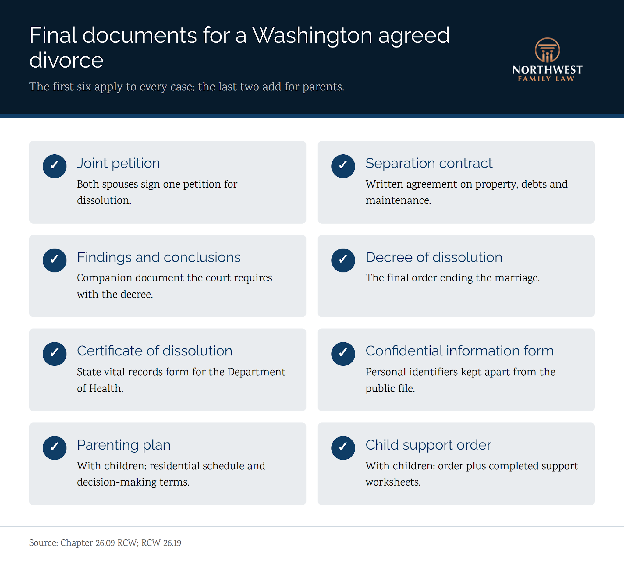
Figure 2: Gather the full document set before filing to lower the risk of rejection. Source: Chapter 26.09 RCW; RCW 26.19.
Local King County and Snohomish rules may add forms, such as the parenting seminar certificate. Missing or mismatched forms are the main reason papers get rejected. Refiling adds weeks and sometimes another fee.
Where Do Agreed Washington Divorces Get Expensive?
Agreed divorces get expensive at five asset types, each needing an extra step. The step, not the agreement, creates the cost.
Two Washington rules sit behind all five. Community property under RCW 26.16.030 means most assets gained during the marriage belong to both spouses. A just and equitable division under RCW 26.09.080 is the court’s standard for dividing marital property, and it is not automatically 50/50.
- House with a mortgage: refinance or deed, plus a real estate excise tax exemption affidavit under WAC 458-61A, triggering lender and recording costs.
- 401(k) or pension: a QDRO, triggering preparer and plan administrator costs.
- Stock options and RSUs: valuation first, triggering financial analysis costs.
- Business interest: valuation first, triggering appraisal costs.
- Vehicles: title transfer, triggering Department of Licensing fees.
Know which of these apply before you sign, and the agreement stays workable. We think ahead.
What Happens When A Joint Petition Breaks Down?
If a spouse stops cooperating or never signs, the case moves from a joint petition to a petition with service. That adds service cost and time, and it may lead to the default route.
You file a petition alone and have your spouse served with the papers. Your spouse then has a set time to respond. If no response comes, you can ask the court for a default order, which lets the case finish without the other spouse’s signature.
The 90-day count runs from filing and service, so late service pushes the earliest decree date back. Our post on serving a missing spouse covers what happens when a spouse cannot be found. If your spouse responds and disagrees, the case becomes contested, which adds hearings, disclosures and months to the timeline.
Frequently Asked Questions
What Percent Of Divorces Are Uncontested?
No reliable Washington figure is available. National counts track how many divorces happen, not whether they were contested. Most agreed cases finish through a joint petition and a decree of dissolution.
What Is The Biggest Divorce Mistake?
The biggest process mistake is signing an agreement before checking how retirement accounts, stock compensation and the home will actually be transferred. The second is filing incomplete or mismatched forms. Both lead to rejection, delay or a second round of orders.
A Clear Next Step For Your Washington Divorce
An agreed case still deserves a plan, because the decree shapes your children’s routines and your family’s finances for years. At Northwest Family Law, P.S., your attorney and paralegal lay out the forms, transfer orders and timeline before anything is filed.
That keeps surprises small. Our team has earned 120+ five-star reviews from Washington families.
Ready to plan your agreed divorce? Talk with Northwest Family Law, P.S. about your costs, forms and timeline before you file.