
To file for divorce (dissolution of marriage) in Washington, one spouse files a Petition for Dissolution of Marriage with the county Superior Court clerk and serves the other spouse. A judge cannot enter the decree until at least 90 days have passed. Most people reach this step worried about one thing: getting the first filing right so nothing is rejected or delayed.
That worry is reasonable, and it is manageable. Below, our divorce attorneys explain the parts that usually cause trouble: what the clerk rejects, what the Summons restrains on day one, and how the 90 days are counted.
If you are ready to start your Washington divorce or want a clear plan before you file, contact Northwest Family Law to schedule a consultation.
Key Takeaways
- Washington is a no-fault state. You file the Petition for Dissolution of Marriage with the Superior Court clerk in the county where either spouse lives.
- The Summons restrains both spouses from day one, including transferring or hiding property and removing the children from the state.
- A judge cannot enter the decree until 90 days after the later of filing or service, even when both spouses agree.
How Do You File For Divorce In Washington in 2027?
You file for divorce in Washington in five steps:
- File: the Petition for Dissolution of Marriage goes to the county Superior Court clerk.
- Serve: your spouse receives the court forms.
- Wait: the response period runs.
- Disclose: both spouses exchange financial information.
- Finish: final orders go to the judge after 90 days.
Fault plays no part. According to DivorceNet, “irretrievably broken” is the only legal ground for divorce in Washington State. The petition does not need to prove anyone did anything wrong.
The petitioner is the spouse who files. The respondent is the spouse who receives the court forms.
Where Can You File In Washington?
You can file in the Superior Court of the county where either spouse lives. One spouse must live in Washington or be a member of the armed forces stationed here. According to DivorceNet, there is no minimum time either spouse must have lived in the state.
A judge also needs jurisdiction, meaning legal power, over your spouse and your children. DivorceNet notes the court has that power over a spouse who lives in Washington, or over a spouse who lived here with you during the marriage while you still live here.
For children, the general rule is that they must have lived in Washington for the six months before filing. Without that authority, a judge may be unable to divide property, order support or approve a parenting plan. A parenting plan is the court order that sets where your children live and how decisions get made.
Eastside residents in Kirkland, Bellevue, Redmond, Sammamish, Mercer Island and Medina file in King County Superior Court. Its courthouses are in Seattle and Kent. Snohomish County residents file in Everett.
Which Court Forms Does A Washington Divorce Need?
A Washington divorce needs approved court forms at two stages: a packet that opens the case and final orders that close it. All are free to print at courts.wa.gov and WashingtonLawHelp.
What Goes In The Filing Packet?
The filing day packet is the Petition (FL Divorce 201), the Summons, the Confidential Information form and the Financial Declaration (FL All Family 131). Parenting and child support forms are added when children are involved. According to DivorceNet, Washington requires official court forms, and FL Divorce 201 starts the case with information about the spouses, the marriage and the property.
The packet can hold seven forms, four core and three conditional:
- Petition (FL Divorce 201): always.
- Summons: always, unless your spouse joins the petition.
- Confidential Information form: always.
- Financial Declaration (FL All Family 131): your core financial disclosure.
- Parenting Plan (FL All Family 140, current version): if a child is under 18.
- Child support worksheets: if a child is under 18.
- Joinder (FL All Family 119): if your spouse agrees to join.
The petition is signed under penalty of perjury. It does not need a notary. It goes to the county Superior Court clerk, and the Department of Health only receives the dissolution report later.
Packets usually come back for three reasons: an outdated form version, missing financial disclosure, or no Parenting Plan in a case with children. Checking each form’s version date on courts.wa.gov the day you file prevents the first one.
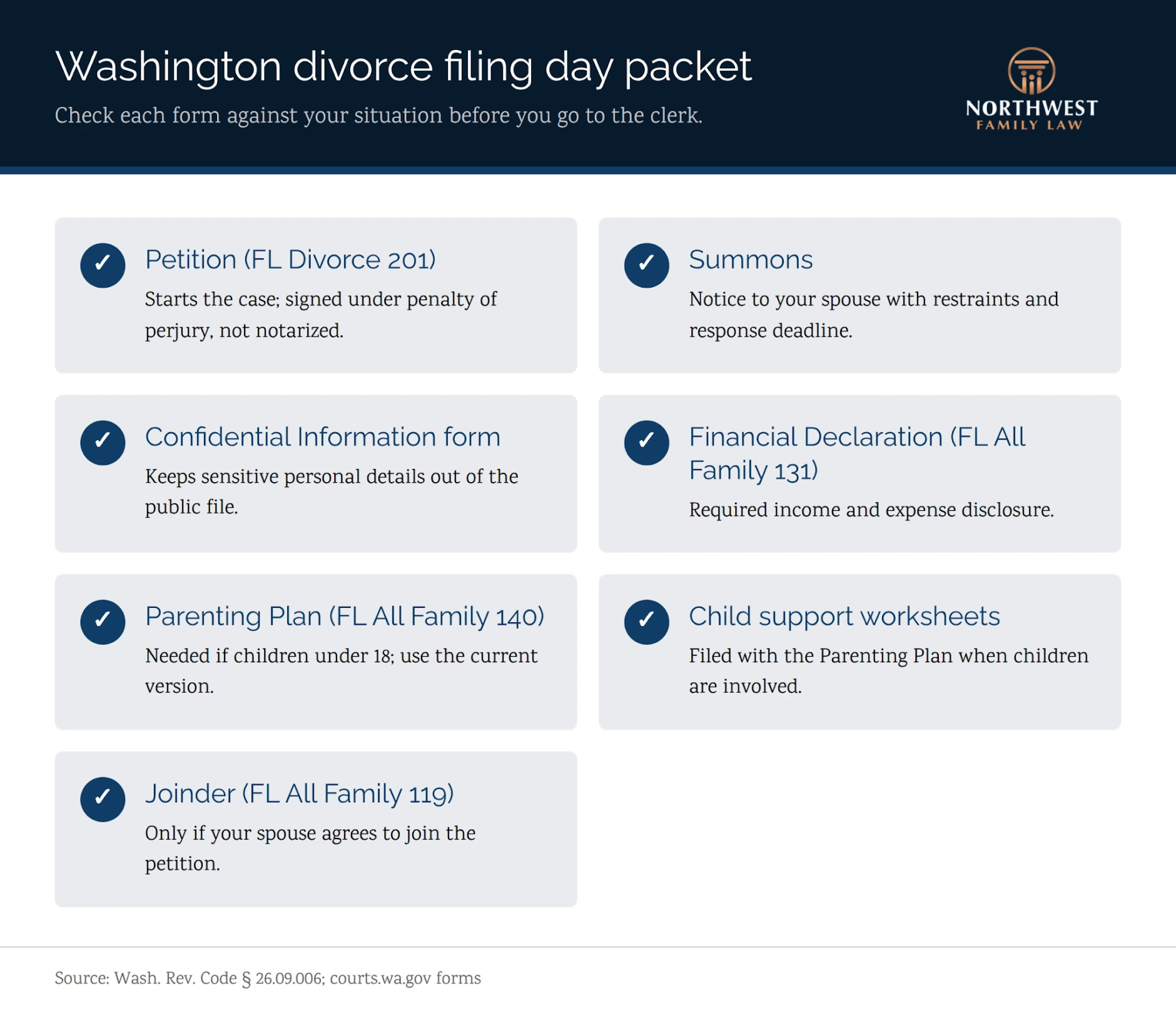
Figure 1: Bring the current version of each form your case requires. Source: Wash. Rev. Code § 26.09.006; courts.wa.gov forms.
Which Final Orders End The Marriage?
Two final orders end the marriage: Findings and Conclusions (FL Divorce 231) and the Decree of Dissolution (FL Divorce 241), both signed by the judge. The Decree of Dissolution legally ends the marriage and sets its terms.
Before these orders, both spouses exchange financial disclosure. Parents also complete any parenting seminar their county requires. After the decree, the county sends a dissolution report to state vital records.
How Is The Filing Fee Set?
The Washington filing fee is set by statute plus county surcharges, so it differs by county and changes over time. Published figures for King County conflict. One page lists $314 and another lists $364, and neither is confirmed here.
Confirm the current amount with the King County Superior Court Clerk or the courts.wa.gov fee schedule on the day you file. A household at or below 125% of the federal poverty guidelines can ask the court to waive the fee.
What Does A Washington Summons Restrain?
Under RCW 26.09.060, the Summons restrains the petitioner from the moment of filing and the respondent from the moment of service. Both spouses are bound from day one. A restraint is a court order not to do certain things while the case is open.
Three acts are restrained:
- Transferring, hiding or encumbering property outside the usual course of business or for necessities. Encumbering means borrowing against it.
- Harassing the other spouse.
- Removing the children from the state.
Three things stay allowed:
- Paying ordinary living expenses.
- Running a business in the ordinary way.
- Paying for the case itself.
Breaking a restraint can lead to contempt, a court finding that someone disobeyed an order. It also weakens that spouse’s credibility when the judge divides property.
How Do You Serve Your Spouse In Washington?
You serve your spouse by delivering the Summons and Petition under the court rules, unless your spouse joins the petition or signs an acceptance of service. Service usually means an adult who is not part of the case hands the forms to your spouse.
According to DivorceNet, Washington has no separate, expedited procedure for uncontested divorce. The respondent can instead join by signing the joinder section of the petition or FL All Family 119. Then no formal service or response is needed.
DivorceNet also notes that a joined spouse can still file a response before the judge signs final orders. The case then proceeds as contested.
A served spouse has 20 days to respond, or 60 days if served outside Washington. When no one knows where a spouse is, the court expects a diligent search before it allows service by publication. A diligent search is a documented effort to find them. Learn more about serving a missing spouse.
| Situation | Where to file | Service method | Response deadline | 90-day clock |
|---|---|---|---|---|
| Spouse cooperative | Either spouse’s county; Eastside files in King | Joinder or acceptance of service | Joinder: none. Acceptance: 20 days | Joinder: from filing. Acceptance: from service |
| Spouse out of state | Your county, if court has jurisdiction | Service outside Washington, per court rules | 60 days | Starts at service |
| Whereabouts unknown | Your county | Diligent search, then publication | Longer; confirm on the Summons | Waits until service completes |
Figure 2: Your spouse’s location and cooperation decide the service method and the 90-day start. Source: Wash. Rev. Code § 26.09.030; King County Superior Court.
When Is The Earliest Decree Date In Washington?
The earliest decree date in Washington is 90 days after filing and after service (or joinder). The court cannot enter the decree early, even when both spouses agree. According to DivorceNet, even an uncontested divorce requires this mandatory 90-day waiting period.
The clock runs from the later of filing or service. Take a King County case filed January 5 and served January 12. The response is due February 1, 20 days after service, and the earliest decree is April 12.
Between those dates, both spouses exchange financial disclosure. Final orders should be ready to submit by April 12.
With joinder there is no service date, so the clock runs from filing. The same January 5 filing reaches its earliest decree on April 5.
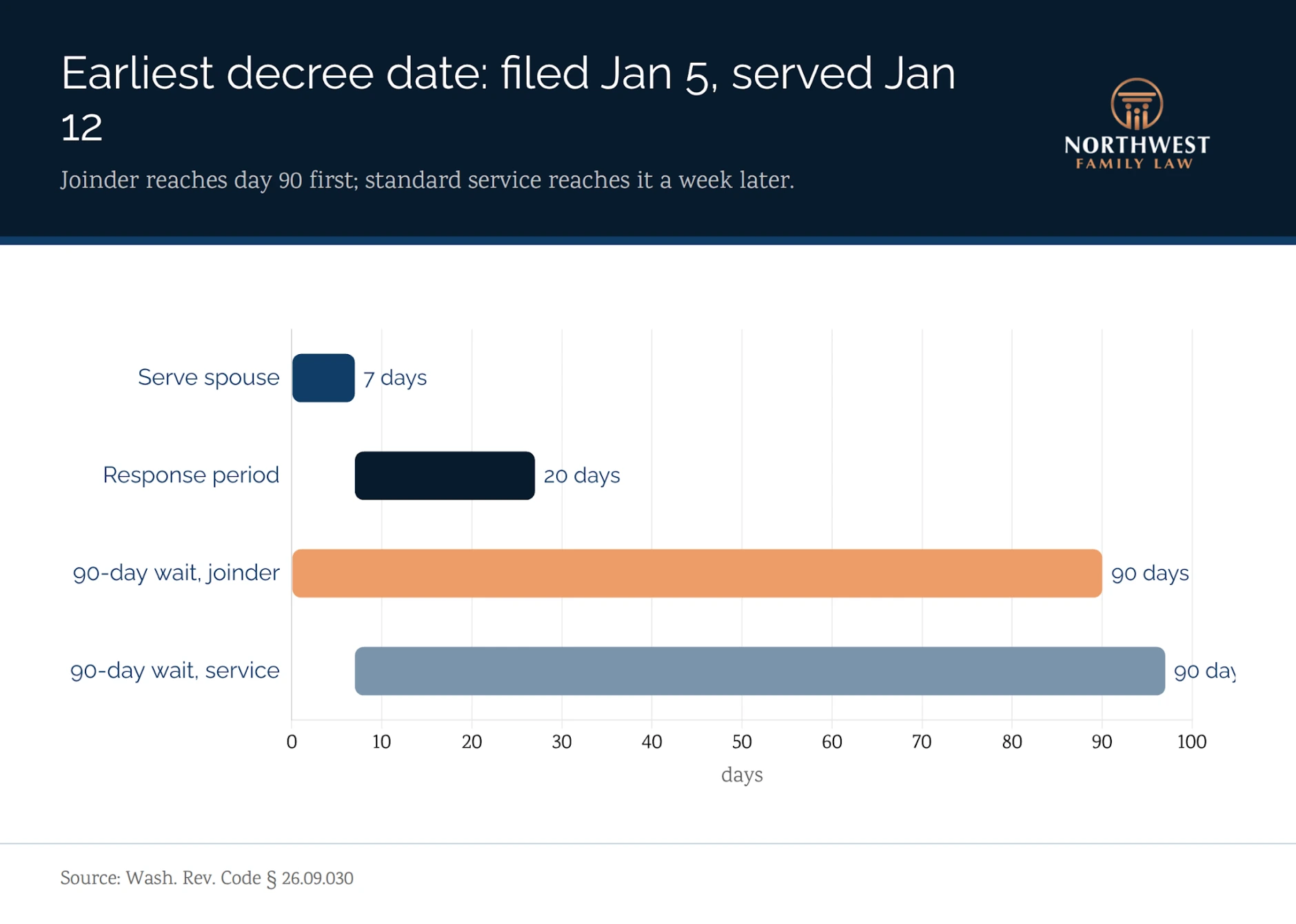
Figure 3: Joinder gives an earliest decree of Apr 5; standard service gives Apr 12. Source: Wash. Rev. Code § 26.09.030.
Some needs cannot wait 90 days, such as the children’s schedule or who pays the mortgage. Courts handle those through temporary orders during the wait.
Which Washington Divorce Path Fits You?
There are four Washington divorce paths: joinder, standard service, default and safety-first. Which one applies depends on how your spouse responds and whether safety is a concern.
- Joinder: your spouse agrees on everything. The first 30 days go to signing the packet and drafting final orders.
- Standard service: your spouse is cooperative, but terms are open. The first 30 days center on the response and financial disclosure, which sets up mediation, negotiation or court.
- Default: no response arrives by the deadline. The petitioner can then ask the court to proceed without the respondent.
- Safety-first: domestic violence is part of the picture. A protection order under RCW 7.105 and a safe service plan come before the petition.
On the joinder path, a separation contract carries weight. A separation contract is a written agreement dividing property, debts and support. According to DivorceNet, the judge generally must follow a signed one, except for parenting arrangements, unless it was unfair when signed.
On the safety-first path, the first 30 days focus on safety. Our page on safety concerns in divorce explains that work.
Are Any Assets Untouchable In A Washington Divorce?
No. Washington has no automatically protected assets, because under RCW 26.09.080 the court may divide separate property as well as community property, and fault is not considered.
The first step is characterization, which means sorting each asset as separate or community. Inheritance and assets owned before marriage start as separate. What happens to them afterward shapes the argument:
- An inheritance kept in its own account stays easier to trace as separate.
- The same funds used on the family home invite a commingling argument, meaning the money mixed with community property and may have changed character.
Learn more about what counts as separate property. When money questions are complex, we can bring local financial planners into the plan.
Starting Your Washington Divorce On Steady Ground
Filing is the first real step, and knowing the order of events lowers the pressure. At Northwest Family Law, P.S., we explain each step and why it matters.
We think ahead, so you are ready if your case needs a judge. Your attorney and paralegal on the file are the people to call, and our whole team stays on the case if an attorney changes.
What usually happens next is a conversation about your family and which path fits. You can begin by talking with our team, by phone or at our Kirkland or Bellevue office.
A lower-pressure start is our Washington calculators or Video Resource Library. A clear plan now makes a stable life after the decree more reachable.